
Service KPIs
Utilizing data to enhance service quality, customer satisfaction, and operational effectiveness.
What are Service KPIs?
Service analytics involves analyzing data related to service performance to enhance delivery, customer satisfaction, and overall business outcomes. This practice includes collecting and interpreting various metrics, such as service usage (customer numbers, frequency, and duration), response time to customer queries, and service quality based on predefined criteria or feedback. Monitoring these metrics allows businesses to gauge service popularity, efficiency, and customer satisfaction. By leveraging service analytics, organizations can streamline operations, improve customer loyalty, and adapt services to evolving customer expectations, ensuring competitiveness in the market.
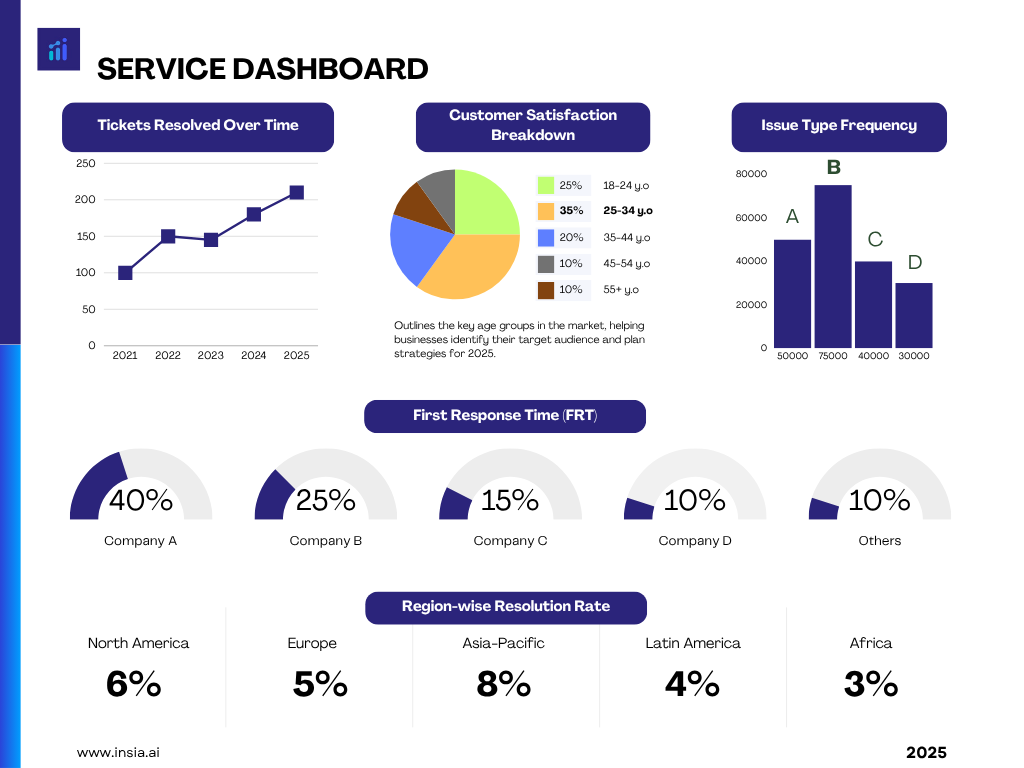
Benefits of Tracking Service KPIs
1) Service Quality Improvement: Service analytics allows businesses to gain insights into customer interactions, feedback, and service performance metrics. By analyzing this data, companies can identify areas for improvement, monitor service quality, and make data-driven decisions to enhance the overall customer experience. This leads to increased customer satisfaction, loyalty, and positive word-of-mouth referrals.
2) Operational Efficiency Optimization: Service analytics helps businesses identify inefficiencies in service delivery processes and operations. Companies can identify bottlenecks, streamline processes, and allocate resources by analyzing service metrics, such as response time, resolution time, and service requests. This leads to improved operational efficiency, reduced costs, and faster service delivery.
3) Personalized Service and Customer Segmentation: Service analytics enables businesses to segment their customer base and provide customized service experiences. Companies can understand customer preferences, behavior patterns, and needs by analyzing customer data. This helps tailor service offerings, communication channels, and engagement strategies to different customer segments, resulting in more targeted and effective service delivery.

-
Above 3 Days Open SR Demo
COUNT (SRN)
-
Adherence to Preventive Maintenance Schedule
(Scheduled Maintenance Performed / Planned Maintenance) * 100
-
Average Response Time to Tickets
Total Time Taken to Respond to Tickets / Total Tickets
-
Average Time to Close Tickets
Total Time Taken to Close Tickets / Number of Tickets
-
BD RFT Copy
(Number of Breakdowns Resolved Right First Time / Total Number of Breakdowns)* 100
-
Contract Utilization Rate
(Utilized Contracts / Total Contracts) * 100
-
Cost per Service Incident
Total Service Cost / Number of Incidents
-
Cost-to-Serve Ratio
(Total Service Costs / Total Revenue)
-
Customer Acquisition Cost (CAC)
(Total Cost of Customer Acquisition / Number of New Customers)
-
Customer Churn Prediction Accuracy
Predicted Churn Accuracy / Total Churn Events
-
Customer Complaint Resolution Rate
(Resolved Complaints / Total Complaints) * 100
-
Customer Feedback Score
Average Feedback Rating from Customers
-
Customer Follow-Up Rate
(Follow-Up Contacts / Total Customers) * 100
-
Customer Inquiry Response Time
Average Time to Address Customer Inquiries
-
Customer Lifetime Value (CLV)
Total Revenue from Customer - Cost to Acquire
-
Customer Retention Rate
(Retained Customers / Total Customers) * 100
-
Customer Satisfaction Index (CSI)
Average Customer Satisfaction Score
-
Customer Upsell and Cross-Sell Rate
(Upsell and Cross-Sell Revenue / Total Revenue) * 100
-
Customer Wait Time
Average Customer Wait Time for Service
-
Downtime Due to Service Issues
Total Downtime Due to Service Delays
-
Equipment Failure Rate
(Equipment Failures / Total Equipment)
-
Field Service Productivity
(Service Orders Completed / Technician Hours Worked)
-
Field Service Profitability
(Field Service Revenue - Field Service Costs) / Field Service Revenue
-
Field Technician Travel Time
Total Travel Time for Field Technicians
-
First-Time Fix Rate (FTFR)
(Issues Resolved on First Visit / Total Issues) * 100
-
Maintenance Contract Renewal Rate
(Renewed Contracts / Total Contracts) * 100
-
Mean Time Between Failures (MTBF)
Mean Time Between Failures Analysis
-
Mean Time to Repair (MTTR)
Total Repair Time / Number of Repairs
-
Missed SLA Penalties
Total Penalties for SLA Breaches
-
Net Promoter Score (NPS)
(Promoters - Detractors) / Total Responses
-
Number of Open Tickets
Open Tickets at the End of the Period
-
Number of Repeat Service Calls
Number of Repeated Calls for Same Issue
-
Number of Service Requests
Total Customer Requests Logged
-
Number of Tickets Handled per Technician
Total Tickets Handled / Number of Technicians
-
On-Time Service Delivery Rate
(Services Delivered On-Time / Total Service Requests) * 100
-
Parts Inventory Accuracy
(Accurate Inventory Records / Total Inventory) * 100
-
Parts Replacement Cost Analysis
(Total Cost of Parts Replaced / Total Service Cost)
-
Predictive Maintenance Accuracy
(Predictive Maintenance Successes / Total Maintenance Events) * 100
-
Profitability by Service Segment
(Profit per Segment / Total Profit)
-
Recurring Incident Analysis
Recurring Issues Count / Total Issues
-
Revenue from Value-Added Services
Revenue from Add-On Services / Total Revenue
-
Revenue per Service Contract
Revenue Generated / Total Service Contracts
-
Service Contract Coverage
(Contracts Sold / Total Customers) * 100
-
Service Cost per Hour
Total Service Cost / Total Hours Worked
-
Service Cost Variance
(Budgeted Service Cost - Actual Service Cost) / Budgeted Service Cost
-
Service Delivery Time Analysis
Delivery Time Trends for Services
-
Service Incident Trend Analysis
Incident Trends Over Time
-
Service Level Agreement (SLA) Compliance
(SLA Adhered Requests / Total SLA Requests) * 100
-
Service Order Accuracy Rate
(Accurate Service Orders / Total Service Orders) * 100
-
Service Order Completion Rate
(Completed Service Orders / Total Service Orders) * 100
-
Service Profit Margin
(Service Revenue - Service Costs) / Service Revenue
-
Service Revenue Growth Rate
(Current Service Revenue - Previous Service Revenue) / Previous Service Revenue
-
Service Team Effectiveness
Performance Score from Customer Ratings
-
Service Utilization Rate
(Billable Hours / Total Hours Available) * 100
-
Service Workflow Efficiency
(Workflow Time Saved / Total Workflow Time)
-
Technician Response Time
Average Time Taken by Technicians to Respond
-
Technician Scheduling Efficiency
(Optimized Schedules / Total Schedules) * 100
-
Technician Utilization Rate
(Technician Work Hours / Total Available Hours) * 100
-
Unclaimed SR
COUNT (SRN)
-
Uptime Percentage
(Uptime Hours / Total Available Hours) * 100
-
Warranty Claim Trend Analysis
Warranty Claims Over Time
-
Warranty Cost as % of Revenue
(Warranty Cost / Total Revenue) * 100
-
Warranty Repair Completion Time
Average Time to Complete Warranty Repairs